

Federal Contracting Opportunities and Compliance Risks in Aerospace, Directed Energy, and Defense Tech

Updated: Sep 18
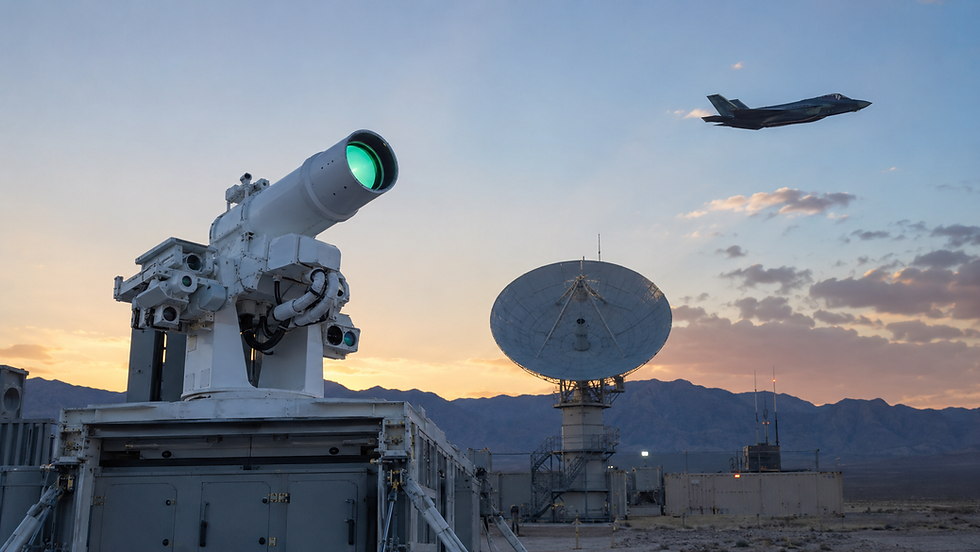
Federal investment in aerospace, directed energy, and defense technology is creating meaningful opportunities for companies that can move quickly, protect sensitive information, and operate within the federal procurement framework. But in these sectors, technical capability alone is rarely enough. Contractors also need disciplined systems for conflicts of interest, cybersecurity, data rights, sourcing restrictions, and teaming arrangements before a promising opportunity becomes a compliance problem.
Here’s what contractors and business leaders should understand to compete effectively in 2026 and beyond.
Current Momentum in These Sectors
The Department of Defense continues to prioritize technologies that can deliver asymmetric advantages, including directed energy systems such as high-energy lasers and high-power microwaves. This focus spans basic research through prototyping, manufacturing, and eventual fielding.
Regions with concentrations of national laboratories, Air Force research facilities, and testing infrastructure are particularly active. For example, areas like Albuquerque, New Mexico, benefit from this combination of assets, though similar dynamics exist in other defense and technology clusters nationwide.
Acquisition pathways are evolving to support faster development cycles, with greater use of flexible mechanisms alongside traditional contracting methods.
Key Contracting Opportunities
Several avenues are especially relevant:
• Prototyping and Experimentation — Other Transaction Agreements (OTAs) and related flexible authorities are being used more frequently for rapid development of advanced technologies. Recent Department of Defense policy has encouraged broader use of OTAs, particularly for prototyping efforts.
• Manufacturing, Integration, and Sustainment — As systems move from demonstration toward production and operational use, opportunities grow in manufacturing, supply chain support, and long-term sustainment.
• Research and Technology Maturation — Broad Agency Announcements, cooperative agreements, and targeted research programs remain active, especially for technologies that bridge laboratory work and operational requirements.
• Teaming and Subcontracting — Prime contractors continue to seek capable partners who combine strong technical performance with reliable compliance practices.
Understanding where your capabilities align with current priorities—and preparing proposals that address both performance and compliance expectations—is essential.
Critical Compliance Areas
Federal contracting in technically sensitive sectors carries specific risks. The most common areas requiring attention include:
Organizational Conflicts of Interest (OCI)
Work performed for government laboratories, research centers, or other federal entities can create actual or potential conflicts when pursuing related contracts.FAR Subpart 9.5 requires contracting officers to identify, evaluate, and resolve organizational conflicts of interest, and OCI risk is commonly analyzed through three recurring fact patterns: impaired objectivity, biased ground rules, and unequal access to nonpublic information.
Data Rights and Intellectual Property
Government contracts involve detailed rules governing technical data, computer software, and patent rights. When technology has roots in federally funded research or laboratory collaboration, the allocation of rights can become especially nuanced. Planning for both current performance and future commercialization is important.
Supply Chain Security and Cybersecurity
CMMC is now moving through phased implementation. The DFARS acquisition rule became effective November 10, 2025, and applicable solicitations and contracts are beginning to incorporate CMMC status and assessment requirements, with Level 2 third-party assessment requirements becoming increasingly important as the rollout progresses.
Labor and Employment Compliance
Prevailing wage rules, proper worker classification, and related requirements remain frequent areas of focus during audits, particularly on contracts involving engineering support, testing, or technical services.
Strategic Best Practices
Companies that perform well in these sectors consistently apply several practices:
• Involve contracts and compliance professionals early in capture and proposal planning.
• Develop clear OCI policies and conduct regular assessments, especially when teaming across government, prime, and subcontractor roles.
• Build productive relationships with program and contracting personnel while maintaining strict compliance boundaries.
• Strategically layer available federal, state, and local incentives with contract work where appropriate.
• Invest in compliance infrastructure—policies, training, and documentation—before it becomes urgent during a proposal or audit.
Treating compliance as a competitive advantage rather than a cost center tends to produce stronger results over time.
What to Watch in 2026 and 2027
Several trends are likely to influence the landscape:
• Continued emphasis on rapid fielding of advanced capabilities, including directed energy systems.
• Ongoing focus on domestic manufacturing and resilient supply chains.
• Expanded use of flexible acquisition authorities alongside traditional FAR-based contracts.
• Heightened attention to conflicts of interest and supply-chain integrity.
Organizations that monitor these developments and adapt their processes accordingly will be better positioned to pursue available opportunities.
References
1. Department of Defense, Critical Technology Areas, https://www.cto.mil/cta/ (identifying Scaled Directed Energy as a priority area). See also Congressional Research Service reports on directed energy weapons programs.
2. U.S. Government Accountability Office, Other Transaction Agreements: Improved Contracting Data Helps Assess Effectiveness (GAO-25-107546, September 2025); Secretary of Defense Memorandum, “Directing Modern Software Acquisition to Maximize Lethality” (March 6, 2025); Executive Order on modernizing defense acquisitions (April 2025).
3. Federal Acquisition Regulation (FAR) Subpart 9.5 — Organizational and Consultant Conflicts of Interest; see also proposed FAR rule on preventing organizational conflicts of interest (Federal Register, January 15, 2025).
4. Department of Defense Chief Information Officer, About CMMC, https://dodcio.defense.gov/CMMC/about/ (phased implementation began November 10, 2025, with Level 2 third-party assessment requirements phasing in during 2026).
5. Department of Defense, Other Transactions Guide, Version 2.0 (July 2023).
6. FAR Subpart 35.016, Broad Agency Announcements; see also DARPA guidance on Broad Agency Announcements and Research Announcements.
7. DFARS 252.227-7013, Rights in Technical Data—Other Than Commercial Products and Commercial Services; DFARS 252.227-7014, Rights in Other Than Commercial Computer Software and Other Than Commercial Computer Software Documentation; DFARS 252.227-7015, Technical Data—Commercial Products and Commercial Services.
8. DFARS 252.204-7012, Safeguarding Covered Defense Information and Cyber Incident Reporting; NIST SP 800-171 Rev. 3, Protecting Controlled Unclassified Information in Nonfederal Systems and Organizations.
9. Federal Register, Cybersecurity Maturity Model Certification (CMMC) Program final rule, 32 CFR Part 170; Federal Register, DFARS rule implementing CMMC contractual requirements.
10. International Traffic in Arms Regulations, 22 CFR Parts 120–130; Export Administration Regulations, 15 CFR Parts 730–774.
11. FAR Part 25 and FAR 52.225-1, Buy American—Supplies; DFARS 252.204-7018, Prohibition on the Acquisition of Covered Defense Telecommunications Equipment or Services.
12. U.S. Department of Justice, Civil Cyber-Fraud Initiative materials concerning False Claims Act enforcement for cybersecurity representations by government contractors.
13. Department of Defense, National Defense Industrial Strategy.



Comments